
SEO for small businesses is about making your website easier to discover when potential customers search online for the products, services, or information you provide. When I started learning digital marketing and began looking for clients, I built a website so people could learn more about me, my skills, and the services I offered. But I soon realized something important: building a website is not enough. A website needs to be discoverable. If people who need your services cannot find your website, even a well-designed website may not bring the results you are looking for. You may build your website with your customers in mind, explain your services clearly, and provide an easy way for people to contact you. But how do potential customers find you in the first place?

When people need a product, service, or answer, they often search online. For example, someone might search for “digital marketing services for small businesses” or “storytelling for small businesses.” Search engines then try to provide the most relevant and useful results for that search. This is where Search Engine Optimisation plays a major role. Think about your own search habits. When you search for something online, how often do you go through dozens of pages of results? Unless you are researching a very specific topic, you are more likely to look at the results that appear near the beginning.
For a small business, therefore, being visible for relevant searches can create an opportunity to reach potential customers at the moment they are looking for a product, service, or solution.
SEO in Simple Terms: How Search Visibility Works
In simple terms, SEO is about two things:
1. Making your website easier for search engines to interpret
2. Helping the right people discover that content when they search for something relevant
SEO isn’t simply about placing popular keywords throughout a website. At its core, it’s about understanding your audience —what they type into search engines, what they hope to find, and what kind of answer would actually be useful to them.
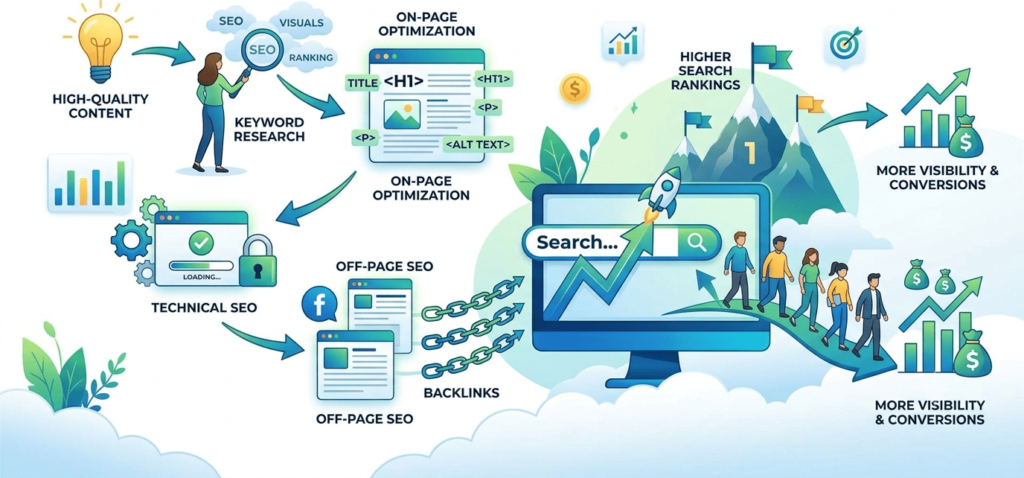
That’s why keyword research and search intent play such an important role in SEO. Consider a small business owner searching for: “How can storytelling help my small business?” They may not be ready to hire a storytelling consultant or buy a service. At this stage, they could simply be exploring the idea, looking for an explanation, or trying to understand whether storytelling is relevant to their business.
The motivation behind that search is what we call search intent. In simple terms, it is the purpose behind a person’s search and the result they are hoping to find. Google uses information from its index and various systems to determine which results are relevant and useful for a particular search. Therefore, SEO is not simply about repeatedly adding the same keyword to a webpage. A well-planned SEO for small businesses strategy can improve how your website is discovered, understood, and experienced by potential customers.
How Does SEO Work? Understanding Crawling, Indexing, and Ranking
Imagine Google as a librarian managing the world’s largest library, while every webpage on the internet is a book.
Before Google can potentially show a webpage in its search results, it generally needs to discover the page, understand and store information about it, and then determine which results are most relevant to a particular search.
These three concepts are commonly described as crawling, indexing, and ranking.
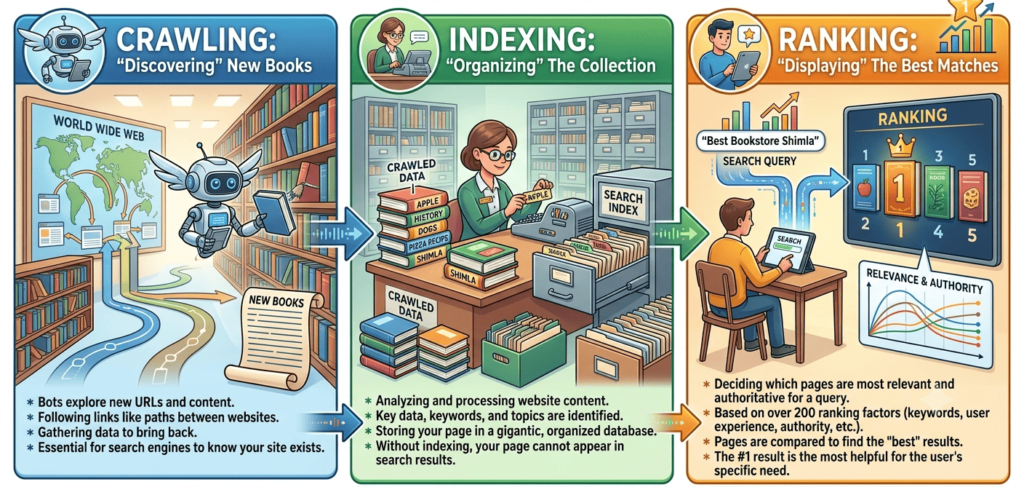
Crawling: Google Discovers Your Webpage
Google uses automated programs called crawlers, including Googlebot, to discover webpages and revisit pages that have changed. These crawlers can discover URLs through links and other available sources. Think of this like a librarian discovering a new book and bringing it into the library.
If Google cannot access or discover a webpage, it may not be able to crawl it properly.
Indexing: Google Understands and Stores Your Content
After discovering a webpage, Google analyzes information available on that page, including its text, images, videos, and other relevant information. If the page meets Google’s requirements for indexing, information about it may be stored in Google’s index. Think of this as the librarian reading and cataloguing a book so that it can potentially be found when someone searches for a particular topic.
Ranking: Google Determines Which Results to Show
When someone performs a search, Google searches through its index and uses numerous systems to determine which results are relevant and useful for that particular query. The results are then presented to the user in an ordered list. Think of it like asking a librarian:
“I’m looking for a book that shows how storytelling can help a small business.”
The librarian would look for books that match your question rather than simply handing you a random book.
Google similarly uses many signals and systems when determining which search results to display.
Crawling, Indexing, and Ranking in Simple Terms
Crawling = Discover the page
Indexing = Understand and store information about the page
Ranking = Determine which relevant results to show
Why SEO for Small Businesses Matters
For a small business, getting noticed can be one of the biggest challenges. You may have a good service, satisfied customers, and a website that clearly explains what you do. But if potential customers cannot find you when they search, your website may not reach the people it was built for. This is where SEO can help.
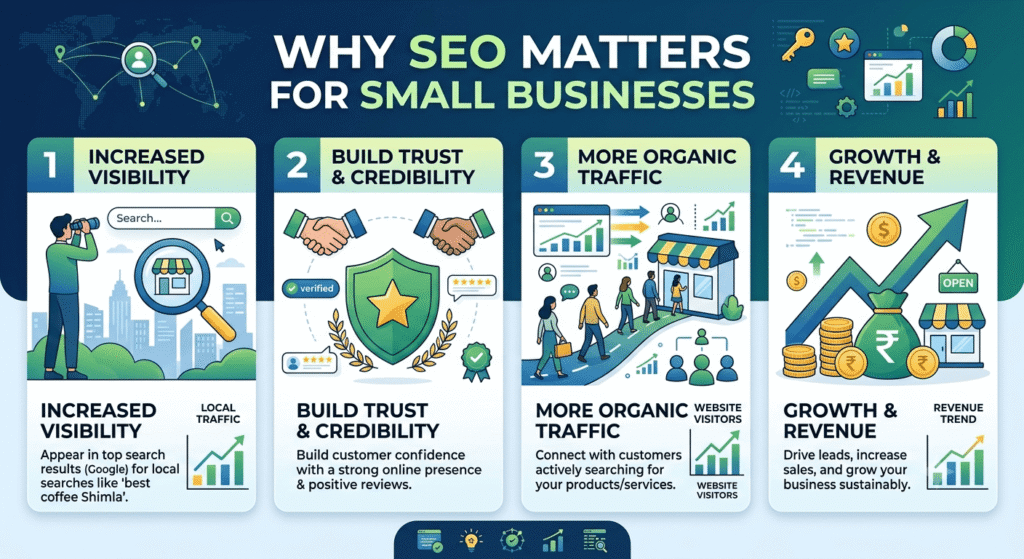
Let’s say you are a small business owner offering accounting services in your city. Someone searches for “accountant for small business near me.” That person already has a need. If your website appears in the search results for a relevant query, you have an opportunity to introduce that person to your business. This is one of the reasons SEO can be important for small businesses. A large number of visitors who have no interest in your services may not be as valuable as a smaller number of people who are genuinely looking for what you offer. SEO can also help businesses build visibility over time. A useful service page, blog post, or local landing page can continue to attract visitors from search engines after it has been published. However, SEO should not be treated as a quick way to generate customers. It takes time to create useful content, improve a website, understand what people are searching for, and build a strong online presence.
For a small business owner, the goal is simple:
Make it easier for the people who need your product or service to find and understand your business online. SEO for small businesses is a long-term process, but consistent improvements to your website and content can gradually strengthen your online visibility.
1. What is SEO for small businesses?
SEO helps people find your business when they search on Google. For example, if you offer accounting services, SEO can help your website appear when someone searches for an accountant. The goal is to make it easier for the right people to discover what you offer.
2. Why is SEO important for small businesses?
Imagine spending time and money building a website, but hardly anyone visits it. That is where SEO can help. It gives your business a better chance of appearing when potential customers search for the products or services you provide.
3. How does SEO work for a small business website?
Think about what your customers might search for when they need your services. SEO starts with understanding those searches and creating useful pages that answer their questions. It also involves making sure Google can find and understand your website.
4. How long does SEO take to show results?
SEO is not something that usually works overnight. It may take several months to see meaningful results, depending on your website, competition, and the improvements you make. Instead of expecting immediate traffic, focus on making your website more useful and easier to find over time.
5. Can I do SEO for my small business myself?
Yes, you can start learning SEO on your own. Begin with simple tasks such as finding the keywords your customers use, improving your page titles, and writing helpful blog posts. Free tools like Google Search Console can also help you understand how people discover your website.
6. What should I focus on first when doing SEO for my small business?
Start by understanding your customers and the problems they want to solve. Find out what they search for online, then make sure your website clearly explains how you can help. Once you have the basics in place, you can work on technical improvements and other SEO activities.